
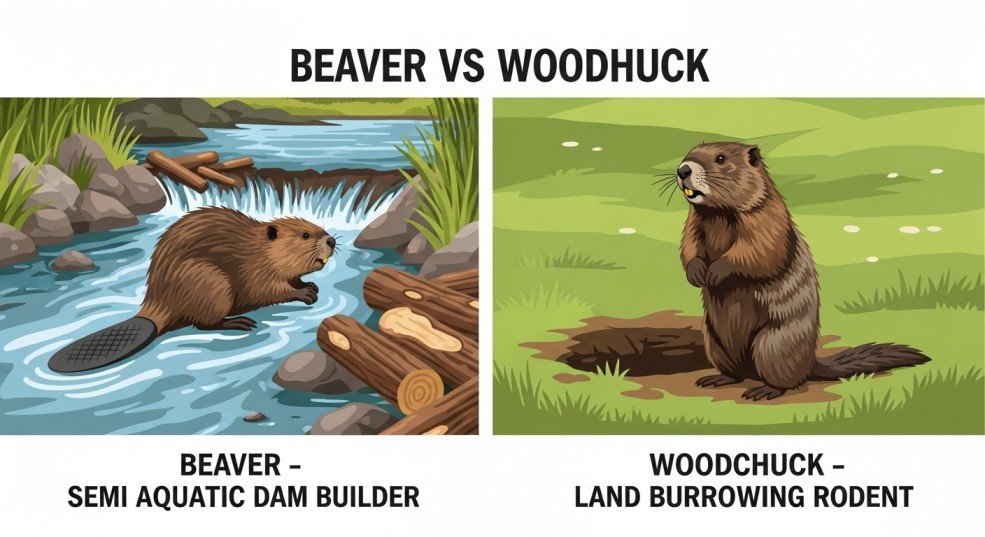
Quick Ans: The main difference between beaver vs woodchuck is habitat and behavior. A beaver is a semi aquatic animal known for building dams in water, while a woodchuck is a land dwelling rodent that digs burrows in soil. Both are mammals, but their lifestyles, appearance, and roles in nature are very different.
Many people search for beaver vs woodchuck because both animals look somewhat similar. Each has a round body, short legs, and strong teeth. Both are rodents. At first glance, it can be hard to tell them apart.
However, they live very different lives.
A beaver spends most of its time in or near water. It builds dams and lodges using wood and mud. A woodchuck, on the other hand, lives on land and creates underground burrows.
Confusion often happens when someone sees a large rodent near water or in a yard. Without knowing the details, people may guess incorrectly.
Understanding the difference between beaver vs woodchuck helps with identification, wildlife awareness, and even property management. For example, beavers can affect water flow, while woodchucks can damage gardens.
This guide explains everything clearly. You will learn definitions, features, advantages, disadvantages, examples, and common mistakes. By the end, you will easily tell them apart.
Quick Answer: Beaver vs Woodchuck
The easiest way to understand beaver vs woodchuck is by looking at habitat and tail type.
| Feature | Beaver | Woodchuck |
|---|---|---|
| Habitat | Water areas like rivers and lakes | Land areas like fields and gardens |
| Tail | Flat and paddle shaped | Short and bushy |
| Lifestyle | Semi aquatic | Fully land based |
| Behavior | Builds dams and lodges | Digs burrows |
| Size | Larger | Smaller |
In simple terms, a beaver lives in water, while a woodchuck lives on land.
What Is a Beaver?
A beaver is a large rodent known for its ability to build dams and lodges. It is one of the most skilled animal builders in nature.
Beavers are found in:
- Rivers
- Lakes
- Streams
- Wetlands
They prefer freshwater environments where they can construct shelters.
Key Features of a Beaver
Several traits make beavers unique:
- Large body
- Thick brown fur
- Strong orange teeth
- Webbed hind feet
- Wide flat tail
The tail helps with swimming and balance.
Common Beaver Behaviors
Beavers are famous for their building skills. Typical behaviors include:
- Cutting down trees
- Building dams to control water
- Creating lodges for shelter
- Storing food underwater
These actions help them survive and protect themselves from predators.
How Beavers Build Dams
Beaver construction follows a clear process:
- Cut down trees using strong teeth
- Drag branches into water
- Stack wood and mud to form a barrier
- Block water flow to create ponds
As a result, beavers create safe environments with deep water.
What Is a Woodchuck?
A woodchuck, also called a groundhog, is a land dwelling rodent that digs burrows underground. It belongs to the marmot family.
Woodchucks are commonly found in:
- Fields
- Gardens
- Forest edges
- Farmland
Unlike beavers, they avoid water environments.
Key Features of a Woodchuck
Woodchucks have distinct characteristics:
- Medium sized body
- Brown or gray fur
- Short bushy tail
- Strong digging claws
- Sharp teeth
Their bodies are built for digging rather than swimming.
Common Woodchuck Behaviors
Woodchucks spend most of their time on land. Their behavior includes:
- Digging deep burrows
- Feeding on plants
- Standing upright to watch for danger
- Hibernating in winter
These habits help them survive changing seasons.
How Woodchucks Build Burrows
Burrow construction involves:
- Digging tunnels underground
- Creating multiple entrances
- Building sleeping chambers
- Adding escape routes
Because of this, their burrows can become large and complex.
Key Differences Between Beaver vs Woodchuck
Habitat
The biggest difference in beaver vs woodchuck is habitat. Beavers live in water based environments. Woodchucks live on land.
Tail Shape
Beavers have flat paddle like tails. Woodchucks have short, bushy tails.
Movement
Beavers swim efficiently using webbed feet. Woodchucks walk and dig using strong claws.
Behavior
Beavers build dams and lodges. Woodchucks dig tunnels and burrows.
Size
Beavers are generally larger and heavier. Woodchucks are smaller in comparison.
Advantages and Disadvantages
Beaver Advantages
Beavers provide important environmental benefits:
- Create wetlands
- Support biodiversity
- Improve water storage
- Reduce erosion
Beaver Disadvantages
However, they can also cause problems:
- Flooding land
- Damaging trees
- Blocking waterways
Woodchuck Advantages
Woodchucks also have ecological roles:
- Aerate soil through digging
- Provide shelter for other animals
- Contribute to ecosystem balance
Woodchuck Disadvantages
At the same time, they can be harmful:
- Damage crops
- Destroy gardens
- Create holes that may cause accidents
Therefore, both animals have positive and negative impacts.
Real World Examples
Near Water Bodies
If you see a large rodent building structures in a river, it is most likely a beaver.
In Gardens
If you notice holes and tunnels in your yard, a woodchuck may be responsible.
Rural Areas
Farmers often deal with both animals. Beavers affect water systems, while woodchucks affect crops.
These examples make the beaver vs woodchuck distinction clearer in daily life.
Regional and Global Usage
North America
Both animals are commonly found across North America. Beavers live near water sources, while woodchucks occupy fields and forests.
Urban Areas
Woodchucks sometimes appear in suburban yards. Beavers are less common in cities but may appear near rivers.
Global Awareness
Beavers are well known worldwide for their engineering skills. Woodchucks are mainly recognized in North America.
Thus, geography plays a role in how people understand beaver vs woodchuck.
Related Concepts and Comparisons
Beaver vs Muskrat
Muskrats are smaller and also live near water, but they do not build large dams like beavers.
Woodchuck vs Groundhog
These are the same animal. The terms are used interchangeably.
Beaver vs Woodchuck vs Squirrel
| Feature | Beaver | Woodchuck | Squirrel |
|---|---|---|---|
| Habitat | Water | Land | Trees |
| Tail | Flat | Bushy | Long and fluffy |
| Behavior | Builds dams | Digs burrows | Climbs trees |
| Size | Large | Medium | Small |
These comparisons help deepen understanding of rodent differences.
Common Mistakes About Beaver vs Woodchuck
Confusing Tail Types
Many people overlook tail shape. The flat tail of a beaver is a clear identifier.
Ignoring Habitat
Location provides a strong clue. Animals near water are rarely woodchucks.
Misidentifying Size
Beavers are much larger than woodchucks. Size helps narrow identification.
Assuming Same Behavior
Not all rodents behave the same way. Each species has unique habits.
Avoiding these mistakes improves wildlife identification skills.
Beginner to Advanced Identification Tips
Beginner Level
Focus on habitat and tail shape first.
Intermediate Level
Observe behavior such as digging or swimming.
Advanced Level
Look at tracks, feeding marks, and environmental changes like dams or burrows.
These steps make identification more accurate over time.
Step By Step Identification Scenario
Imagine you spot an animal outdoors.
If the animal is near water:
- Check for swimming behavior
- Look for flat tail
- Observe dam structures
If the animal is on land:
- Look for burrow holes
- Observe digging behavior
- Check for bushy tail
Using these steps helps identify beaver vs woodchuck correctly.
Exercises With Answers
Exercise 1
Which animal lives in water in the beaver vs woodchuck comparison?
Answer: Beaver.
Exercise 2
Which animal digs underground burrows?
Answer: Woodchuck.
Exercise 3
Which animal has a flat tail?
Answer: Beaver.
Exercise 4
Which animal is commonly found in gardens?
Answer: Woodchuck.
Exercise 5
True or False: Woodchucks build dams.
Answer: False.
When Should You Identify Beaver vs Woodchuck?
Identify a beaver if you:
- See water dams
- Notice tree cutting near rivers
- Observe swimming rodents
Identify a woodchuck if you:
- See burrows in soil
- Notice plant damage
- Spot animals in open fields
Correct identification helps manage wildlife interactions effectively.
FAQs About Beaver vs Woodchuck
What is the main difference between beaver vs woodchuck?
The main difference is habitat. Beavers live in water and build dams, while woodchucks live on land and dig burrows.
Are beavers and woodchucks the same animal?
No. In the beaver vs woodchuck comparison, they are different species with different behaviors and habitats.
Which is bigger, beaver or woodchuck?
Beavers are larger and heavier than woodchucks.
Do woodchucks live near water?
They may live nearby, but they do not depend on water like beavers.
Why do beavers build dams?
They build dams to create safe water environments and protect themselves from predators.
Are woodchucks harmful to gardens?
Yes. Woodchucks can damage plants and crops.
Do beavers hibernate?
Beavers stay active in winter, unlike woodchucks, which hibernate.
Is a groundhog the same as a woodchuck?
Yes. Both names refer to the same animal.
Can beavers damage property?
Yes. Their dams can cause flooding and tree damage.
Which animal is easier to spot?
Woodchucks are often easier to see during the day in open areas.
Conclusion
Understanding beaver vs woodchuck is important for wildlife identification and environmental awareness. Although both animals are rodents, their lifestyles are completely different.
A beaver lives in water and builds dams using wood and mud. This behavior helps create wetlands but can also affect human property. A woodchuck lives on land and digs burrows, often impacting gardens and farmland.
Habitat, tail shape, and behavior provide the clearest differences. Observing these factors makes identification easier.
Choosing the correct identification helps in managing interactions with wildlife. It also improves understanding of ecosystems and animal behavior.
By learning the key differences between beaver vs woodchuck, you can confidently recognize each animal in nature and respond appropriately.
Discover More:-
- Obamacare vs Medicaid: Key Differences, Eligibility, and Coverage Guide
- Fennel vs Anise: Differences, Flavor, Uses, and Cooking Guide

Jennifer Collins is a professional grammar expert and language educator at gramtivo.com, specializing in English grammar, writing skills, and language improvement. She holds a Master’s degree in English Language and Literature from a recognized university in the United States. With years of teaching and content development experience, she is dedicated to helping learners improve their communication skills with clear and practical guidance.